Priority is running ahead of preparedness
Security and resilience are moving up the agenda across the Nordics. But our survey of 2,427 business leaders and decision-makers shows that recognising the risks is not the same as being ready for disruption. Only half say their organisation is well prepared to keep critical operations running through a serious digital disruption.
This year’s report argues for practical resilience: knowing which services must keep running and what they depend on, and proving that backup arrangements work before they are needed.
Key findings
Priority
71% see digital sovereignty growing in importance
58% put greater weight on security when buying connectivity and digital services
Preparedness
50% feel ready to keep critical operations running through a serious digital disruption (Finland 56% · Norway 49% · Denmark 49% · Sweden 47%)
36% expect higher security and resilience investment
12% feel fully prepared for AI-enabled threats
Survey by Opinion for Telenor, August–September 2026. 2,427 business leaders and decision-makers in Norway, Sweden, Denmark and Finland.
Telenor's call to action
Resilience must be tested, not assumed.
Backups only matter if they work under pressure, across power, networks, people and suppliers.
Sovereignty means control, not self-sufficiency.
The aim is deliberate choices and fewer unacceptable dependencies, not building everything at home.
Trust is built before the crisis.
A serious disruption tests systems and trust at the same time, and the relationships needed to respond must already exist.
What Telenor asks for Nordic governments
Read the five priorities in full, p. 28 -›
Set clear resilience outcomes and fund what is required.
Build trusted infrastructure without closing markets.
Coordinate preparedness across sectors and borders.
Exercise together and close the gaps.
Treat trusted communication as an operational capability.
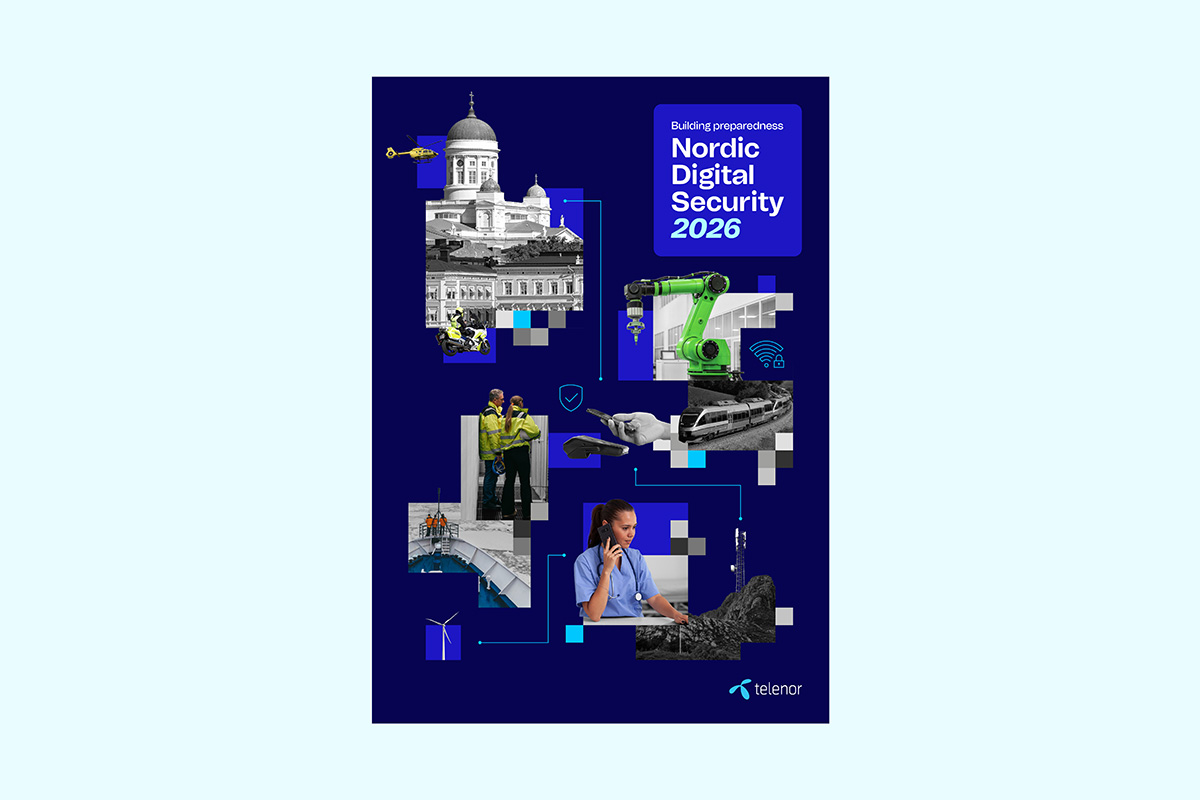
What's in the report
1 Executive summary
Security is climbing the Nordic agenda, but readiness is lagging behind. A short overview of the threats, the survey findings and Telenor's recommendations for businesses and authorities.
2 The Nordic threat picture
From state-backed espionage and sabotage to AI-enabled fraud and supply-chain risk, we map the actors and developments shaping the threats to Nordic businesses.
3 How they attack
Most attacks still begin with a stolen login, an exposed service or a deceived employee. What has changed is how quickly AI and ready-made attack services can exploit them.
4 The Nordic resilience gap
Our survey of 2,427 Nordic business leaders shows security rising up the agenda, yet only half feel ready to keep critical operations running through a serious disruption.
5 From backup to tested continuity
Backup power and spare routes are only the start. Telecom resilience is a system of layers that must be tested together before a crisis hits.
6 Digital sovereignty gets real
Who controls the technology we depend on? How the Nordics can turn digital dependence into resilience through deliberate choices rather than self-sufficiency.
7 Who's keeping your AI in check?
Telenor's Lead for Responsible AI, Zainab Hussain Siddiqui, shares six practical steps for building responsibility into how AI is developed, bought and used.
8 Resilience has a cost
Continuity doesn't happen by accident. Play your way to tested continuity and see how investment, procurement and clear ownership determine who climbs and who slides back.
9 When trust becomes the target
When a network goes down, the consequences extend beyond connectivity. Experts from FFI and Finland's Security Committee explain why trust has to be built before it's needed.
10 Resilience checklist
A practical self-assessment to help businesses and public authorities find their most critical continuity gaps and decide what to fix first.
11 What authorities should prepare for
Five priorities for Nordic governments, from clear resilience targets and funding to joint exercises across borders and trusted crisis communication.